
ABSTRACT
| Burkina Faso has become the world’s most terrorism-affected country, with over two million internally displaced persons as of 2024, largely due to violence from extremist groups such as Jama’at Nasr al-Islam wal-Muslimin. In this context, youth vulnerability is of particular concern, as disruptions in education significantly increase the risk of recruitment into violent extremist organizations. This study examines psychosocial factors influencing the vulnerability of internally displaced youth aged 15–24.
Using a sequential explanatory mixed-methods design, the study integrates quantitative surveys (N = 300) and qualitative interviews (N = 40) conducted across four regions in Burkina Faso between August and September 2025. Structural equation modelling and hierarchical regression were used to assess mediation and moderation effects. Results show that educational disruption strongly predicts recruitment vulnerability (β = 0.54, p < 0.001), explaining 41% of variance. Identity disruption and relative deprivation emerged as key mediating factors, with heightened vulnerability observed approximately 18 months after educational interruption. Access to alternative education was identified as the most effective protective factor. The study highlights its potential as a prevention strategy for reducing recruitment risk among displaced youth and informs policy and humanitarian responses in conflict-affected settings. |
|
1. Introduction
Since 2015, Burkina Faso has faced a profound security crisis marked by a surge in violent extremist attacks, severely disrupting civilian life, especially in the northern and eastern regions. Groups such as Jama’at Nusrat al-Islam wal-Muslimin (JNIM) and the Islamic State in the Greater Sahara (ISGS) have targeted educational institutions, leading to attacks on schools, threats to teachers, and the displacement of entire villages. Consequently, thousands of youths have been deprived of their fundamental right to education.[1]
Educational disruption in conflict settings has significant long-term consequences for identity, social cohesion, and economic stability. Education is not only a means of acquiring knowledge; it is critical for developing social skills, fostering citizenship, and cultivating community ties.[2] Research in conflict-affected areas suggests that education fosters resilience, offering a crucial sense of normalcy and hope amidst chaos.[3]
Preliminary field observations suggest that internally displaced youth (IDYs) experience profound uncertainty as they disconnect from their educational institutions and communities, severing the structured pathways to adulthood that education typically facilitates. This disconnection severs the structured pathways toward adulthood that education typically facilitates. Humanitarian workers report that violent extremist organizations (VEOs) actively recruit from these displaced populations, exploiting grievances and offering alternative forms of belonging and purpose.[4] However, a systematic understanding of how educational disruption influences recruitment vulnerability in this context is critically lacking.[5]
This study addresses this knowledge gap by examining the mechanisms through which educational disruption increases recruitment susceptibility among IDYs in Burkina Faso, while identifying the protective factors at individual, family, community, and structural levels, that can foster resilience. The central argument is that educational disruption predicts heightened vulnerability to VEO recruitment, mediated by identity disruption, relative deprivation, and meaning-seeking deficits.
This study reviews relevant literature on the relationship between educational disruption and recruitment vulnerability, outlines the research methodology, presents and discusses key findings, and concludes with actionable recommendations for future interventions and policy formulation.
Based on this contextual analysis and the gaps identified in the existing literature, this research is guided by the following research questions and formally specified hypotheses:
Research Question 1 (RQ1): Does educational disruption significantly predict vulnerability to violent extremist recruitment among internally displaced youth aged 15–24 in Burkina Faso?
Research Question 2 (RQ2): Through which psychosocial mechanisms does educational disruption translate into increased recruitment vulnerability?
Research Question 3 (RQ3): Which individual, family, community, and structural factors moderate the relationship between educational disruption and recruitment vulnerability?
H1 (Main Effect): Educational disruption significantly predicts vulnerability to violent extremist recruitment among internally displaced youth aged 15–24 in Burkina Faso. Youth experiencing greater educational disruption will demonstrate higher vulnerability to recruitment.
H2a (Mediation – Identity Disruption): Identity disruption significantly mediates the positive relationship between educational disruption and vulnerability. Greater educational disruption increases identity disruption (loss of student identity and educational aspirations), which in turn increases vulnerability to VEO recruitment.
H2b (Mediation – Relative Deprivation): Relative deprivation significantly mediates the positive relationship between educational disruption and vulnerability. Greater educational disruption increases perceptions of relative deprivation, which in turn increases vulnerability.
H2c (Mediation – Meaning-Seeking Deficits): Meaning-seeking deficits significantly mediate the positive relationship between educational disruption and vulnerability. Greater educational disruption increases meaning-seeking deficits, which in turn increases vulnerability.
H3a–H3d (Moderation – Protective Factors): Individual (H3a), family (H3b), community (H3c), and structural (H3d) protective factors each significantly moderate the relationship between educational disruption and vulnerability, such that the effect is weaker when protective factors are higher.
The following literature review develops the theoretical and empirical foundations that justify each of these hypotheses, organizing the evidence along the three axes of the conceptual framework: the direct effect of educational disruption (H1), the psychosocial mediation pathways (H2a–H2c), and the moderating role of protective factors (H3a–H3d).
2. Literature Review
This literature review examines the intersections of educational disruption, forced displacement, and exposure to violent extremism among IDYs in Burkina Faso. This synthesis draws on education research, security studies, development practices, and social psychology to illuminate the complexities of youth vulnerability to radicalization within the Sahel region.
2.1. The Impact of Educational Disruption
Numerous studies show that interruptions to education significantly heighten youth vulnerability to radicalization. The collapse of educational systems leads to marginalization and identity crises, as emphasized by reports from the United Nations Development Program (UNDP) that outline pathways linking educational disruption to increased vulnerability to recruitment.[6]
Educational continuity serves as a protective factor, while a lack of structured pathways makes youth more receptive to extremist narratives. This aligns with global trends wherein young people without viable educational prospects are more susceptible to radicalization.[7] These findings directly ground RQ1 and H1: if educational disruption is a documented predictor of radicalization vulnerability globally, this study tests whether the same relationship holds and through which mechanisms among internally displaced youth in Burkina Faso.
2.2. The Sahel Context
In the Sahel, there is substantial evidence of alarming rates of educational disruption tied to ongoing conflicts. Many IDYs have ceased attending school, with vulnerabilities exacerbated by family separation and insecure access to educational facilities.[8] The erosion of hope among these youths leads recruiters to exploit their despair by offering promises of belonging, financial gain, and social status. In Nigeria, for example, consistent education access deters recruitment into extremist groups like Boko Haram.[9] Similarly, research from East Africa indicates that youths engaged in continuous learning are less likely to be drawn to radical organizations.[10]
In Burkina Faso, VEOs, such as JNIM, operate within specific recruitment dynamics tied to experiences of educational disruptions. The conflict dynamics in Burkina Faso differ from those in neighboring Mali and Niger, where recruitment narratives show distinct variations.[11]
This regional evidence informs H1 and provides comparative grounding for RQ2: the Sahelian context reveals how displacement-induced deprivation and loss of belonging (mechanisms of identity disruption and relative deprivation) operate as pathways from educational loss to recruitment vulnerability.
2.3. The Burkinabe Context
The educational landscape in Burkina Faso has been drastically altered by widespread conflict, leaving over 1.2 million school-aged children out of school.[12] Attacks on academic institutions and threats to teachers have created a generation of youth disconnected from formal learning, elevating their risks of radicalization.
Reports from Human Rights Watch document alarming rates of educational disruption contributing to a cycle of despair among IDYs.[13] Systemic educational disruptions, compounded by unique cultural factors, affect how educational loss translates into recruitment vulnerability. The Burkinabé context thus constitutes the specific empirical terrain against which H1 is tested (RQ1), and within which the psychosocial pathways articulated in H2a–H2c (RQ2) must be understood.
2.4. Addressing Gaps in Previous Research
Despite extensive documentation of links between educational disruption and radicalization, significant gaps remain in the literature, particularly regarding Burkina Faso’s unique circumstances.
Prior research has identified psychosocial mechanisms, such as identity disruption and relative deprivation, that mediate the relationship between educational disruption and vulnerability. However, these have not been rigorously tested in the Sahelian context.[14] Many studies depict youth as passive victims in conflict, overlooking their agency in navigating educational disruptions and recruitment pressures. The absence of longitudinal studies tracking the impacts of educational disruptions further limits understanding of vulnerabilities and protective mechanisms during critical transitional phases. This study aims to address these gaps. Addressing these lacunae is precisely what RQ2 and RQ3 seek to accomplish: RQ2 tests whether identity disruption, relative deprivation, and meaning-seeking deficits (H2a, H2b, H2c) mediate the disruption-vulnerability relationship in this context; RQ3 examines whether individual, family, community, and structural protective factors (H3a–H3d) moderate that relationship.
2.5. Protective Factors and Resilience in Conflict-Affected Youth
Identifying protective factors is essential for developing resilience-promoting interventions in conflict-affected youth. Access to quality education, community cohesion, and strong familial networks are vital components. Emerging research suggests that involvement in community-based educational initiatives is associated with lower rates of radicalization among refugee youth, highlighting the importance of alternative educational pathways.[15]
In Burkina Faso, leveraging cultural identity and community solidarity can enhance resilience among IDYs. This body of evidence directly informs RQ3 and hypotheses H3a–H3d, which posit that individual, family, community, and structural protective factors each moderate the relationship between educational disruption and recruitment vulnerability with higher protective resources attenuating the risk.
2.6. Theoretical Frameworks
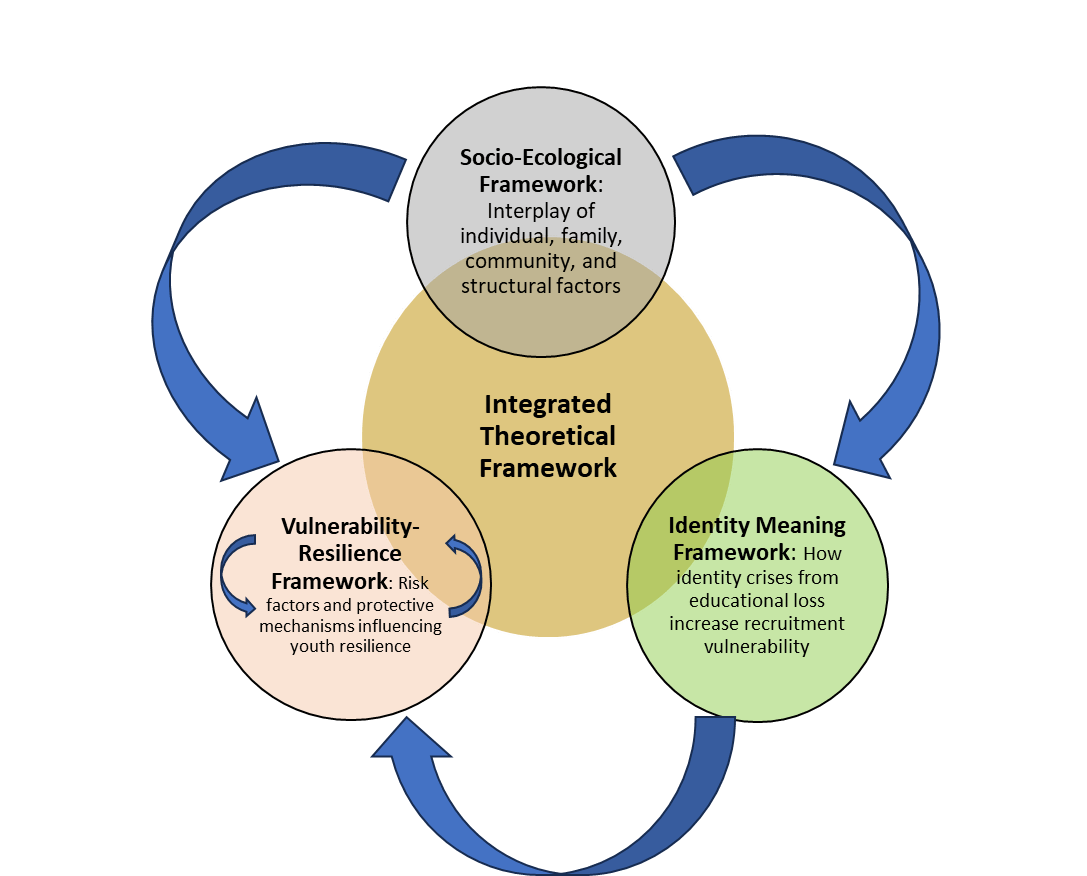
This study employs three interconnected theoretical frameworks to elucidate the interplay between educational disruption, displacement, and radicalization among IDYs in Burkina Faso, each providing a unique lens for examining vulnerabilities and risk mitigation factors.
The Socio-Ecological Framework emphasizes the interconnectedness of social, economic, and political factors affecting educational access and outcomes. It highlights how multi-layered interactions contribute to the challenges faced by IDYs.[16]
The Identity/Meaning Framework focuses on psychosocial mechanisms, examining identity crises and feelings of relative deprivation that manifest as grievances and reveals how educational disruptions can erode youth’s sense of self and belonging, increasing susceptibility to extremist ideologies.[17]
The Vulnerability-Resilience Framework identifies vulnerabilities at individual, family, community, and structural levels while showcasing protective factors that can mitigate these vulnerabilities.[18]
By employing these frameworks, this research aims to develop a comprehensive understanding of how educational disruptions interact with unique stressors in the Sahelian context of Burkina Faso, illuminating pathways for effective educational and humanitarian interventions. Together, these three frameworks provide the theoretical scaffolding that justifies each of the eight hypotheses tested in this study (H1, H2a–H2c, H3a–H3d) and anchors the three research questions in a coherent explanatory logic.
Figure 1- Interrelationship of Theoretical Frameworks in Understanding IDYs Vulnerability and Resilience
Source: The author (November 2025)
To visualize the relationships among educational disruption, psychosocial mechanisms, and recruitment vulnerability among IDYs in Burkina Faso, the following Interrelationship model is proposed:
3. Methodology
3.1. Mixed-Methods Approach
This study employs a sequential explanatory mixed-methods design to examine how educational disruption affects the vulnerability of IDYs to recruitment by VEOs. Integrating quantitative surveys with qualitative interviews provides a comprehensive understanding of the complex factors influencing radicalization.[19]
3.2. Sample Size and Justification
The target sample size is 300 participants, determined through Monte Carlo power analysis (5,000 replications in Mplus 8.0), with medium effect sizes anchored in empirical evidence from comparable contexts and pilot data (N = 60, July 2025). An a priori power analysis established a minimum of 265 participants (Cohen’s f² = 0.15, power ≥ 0.80, α = 0.05) to detect the smallest hypothesized effect (H2c). Increasing this to 300 enhanced robustness and representation across key demographics (age, gender, geography).[20] A stratified sampling method ensured adequate representation of these groups.[21]
3.3. Quantitative Phase
The quantitative phase involves a cross-sectional survey measuring key constructs, including educational disruptions, psychosocial impacts, identity affirmation, and exposure to extremist narratives. The survey instrument was pilot-tested with 30 IDY participants (10 per language group: French, Moore, and Fulfulde) to ensure clarity and cultural relevance across Burkina Faso’s three primary linguistic communities. The full survey was administered in these three languages by native-speaking enumerators, using validated composite measures developed for this study: an Educational Disruption scale capturing school access, continuity, and quality loss (12 items, α = 0.72), and a Vulnerability to Recruitment scale assessing exposure to recruitment vectors including grievance, identity, and social networks (16 items, α = 0.75, adapted from Mercy Corps instruments).[22]
The quantitative data analysis employed Structural Equation Modeling (SEM) via AMOS and SPSS (version 29.0) to examine relationships among variables. SEM was used to identify and model latent constructs (identity disruption, relative deprivation, and meaning-seeking deficits) which mediate the relationship between educational disruption and recruitment vulnerability. The analytical strategy involved systematic testing of mediation pathways (H2a–H2c) and moderating effects of protective factors (H3a–H3d). Model fit was assessed against the following criteria: Comparative Fit Index (CFI) ≥ 0.90, Tucker-Lewis Index (TLI) ≥ 0.90, and Root Mean Square Error of Approximation (RMSEA) ≤ 0.08. A bootstrap validation procedure with 5,000 replications was employed to analyze critical vulnerability thresholds using bias-corrected accelerated confidence intervals. Multicollinearity was assessed using Variance Inflation Factor (VIF) analysis; all predictors had VIF values below the critical threshold (VIF < 3.5, maximum VIF = 2.8), indicating no problematic collinearity.[23]
3.4. Qualitative Phase
The qualitative phase consisted of 40 in-depth interviews and six focus groups, aimed at identifying themes related to IDYs’ experiences of educational disruption and radicalization. A dual-focus approach for coding incorporated predetermined themes and emergent patterns, ensuring a comprehensive understanding. Inter-coder reliability was evaluated using Cohen’s Kappa, targeting a value of 0.80 for strong agreement.[24] To mitigate enumerator biases, extensive training was provided on neutral probing techniques. Sensitive survey items were administered in private settings and chosen language to ensure participants felt secure discussing their experiences. Ongoing monitoring and retraining resulted in a 94% compliance rate.[25]
Summarizing post-interviews strengthened the validity of the qualitative findings.
3.5. Security Risk Mitigation Strategies
Conducting research in Burkina Faso amid ongoing security challenges required a three-tiered risk mitigation strategy encompassing preventive measures, protective protocols, and responsive actions. Local leaders were engaged throughout the process, both to facilitate safe access to vulnerable participants and to reassure them when discussing sensitive topics.[26]
All interviews were conducted in secure, private settings selected based on current security assessments.[27]
3.6. Ethical Considerations
This study received ethical approval from Euclid University, adhering to Burkina Faso’s national ethical framework and the World Health Organization guidelines for research involving vulnerable populations.[28] A dual consent approach was used for participants aged 15-18, requiring written consent from a parent or guardian, followed by the participant’s assent. If parents were unavailable due to displacement, consent was obtained from legally recognized caretakers or community leaders.[29] Data collectors were trained to address trauma, and data were securely stored and anonymized, in compliance with data protection regulations.
4. Findings
4.1. Demographic Profile of Participants
The study sample comprised 300 IDY aged 15–24, with equal regional distribution of 75 participants per region (Centre-Nord, Sahel, Est, Nord), ensuring adequate statistical power for inter-regional comparisons. Age stratification included 100 participants in each of the 15–18, 19–21, and 22–24 age groups. The gender distribution achieved near parity, with 152 males (50.7%) and 148 females (49.3%). Linguistic diversity reflected Burkina Faso’s multilingual reality: Moore (42.0%), Fulfulde (31.0%), Gourmantche (18.0%), French (6.7%), and other languages (2.3%). Displacement duration ranged from 6 to 36 months (mean = 19.4 months, SD = 8.7), with a critical concentration in the 13–24-month window (54.0% of the sample).
Table 1- Demographic Characteristics and Regional Distribution (N = 300)
| Characteristic | Frequency | Percentage | Notes |
| Gender | |||
| Male | 152 | 50.7% | |
| Female | 148 | 49.3% | |
| Age Groups | |||
| 15–18 years | 100 | 33.3% | |
| 19–21 years | 100 | 33.3% | |
| 22–24 years | 100 | 33.3% | |
| Region | |||
| Centre-Nord | 75 | 25.0% | Mean displacement: 18.5 months |
| Est | 75 | 25.0% | Mean displacement: 21.1 months |
| Nord | 75 | 25.0% | Mean displacement: 19.7 months |
| Sahel | 75 | 25.0% | Mean displacement: 24.2 months |
| Displacement Duration | |||
| 6–12 months | 54 | 18.0% | Low vulnerability risk |
| 13–18 months | 78 | 26.0% | Moderate–high vulnerability risk |
| 19–24 months | 96 | 32.0% | High vulnerability risk |
| > 24 months | 72 | 24.0% | Critical vulnerability risk |
Source: Author’s primary data collection across IDP sites in Centre-Nord, Sahel, Est, and Nord regions, Burkina Faso (August–September 2025).
Note: Regional differences in displacement duration are statistically significant (F(2,297) = 18.73, p < 0.001), with the Sahel region exhibiting the longest mean displacement duration, consistent with patterns of conflict intensity.
Subgroup Analysis: Males demonstrated significantly higher vulnerability scores (M = 49.8, SD = 17.2) compared to females (M = 44.6, SD = 16.8), t(298) = 3.21, p = 0.002, d = 0.31. Age group comparisons revealed that the 19–21 cohort exhibited the highest mean vulnerability scores, consistent with the critical identity-formation phase of young adulthood.
4.2. Quantitative Findings: Educational Disruption and Vulnerability
H1 Result: Educational disruption significantly predicts vulnerability to recruitment by VEOs. Regression analysis confirmed a significant positive association (β = 0.54, p < 0.001, R² = 0.41), indicating that educational disruption explains 41% of the variance in recruitment vulnerability. This result corresponds to the coefficient of determination (R²), with the standardized beta (β = 0.54) reflecting the direct effect of educational disruption on vulnerability after controlling for covariates. H1₀ was rejected (p < 0.001); H1 is strongly supported.
IDYs experiencing prolonged educational disruption exhibit notably greater vulnerability to extremist recruitment, as illustrated in Table 2 below.
Table 2- Vulnerability Scores by Duration of Educational Disruption (N = 300)
| Disruption Duration | Sample Size (n) | Mean Vulnerability Score | 95% Confidence Interval | Risk Category |
| < 12 months | 89 | 34.2 | [31.5 – 36.9] | Low –Moderate |
| 12–18 months | 76 | 48.7 | [45.2 – 52.2] | Moderate – High |
| > 18 months | 135 | 61.9 | [58.9 – 65.0] | High – Critical |
Source: The author (November 2025).
Note: Duration-based analysis confirms a clear dose-response relationship between length of educational disruption and recruitment vulnerability. The 18-month inflection point was confirmed as optimal (AIC = 2,847.3) versus alternative cut-points of 16–20 months (AIC range: 2,851.7–2,863.2); bootstrap CI for the inflection = [17.2, 18.6].
4.3. Mediation Analysis: Psychosocial Mechanisms
SEM mediation analysis tested hypotheses H2a–H2c. The overall SEM demonstrated acceptable model fit: χ²/df = 2.34, CFI = 0.930, TLI = 0.920, RMSEA = 0.067 [90% CI: 0.058–0.076]. The total mediation accounts for 64% of the effect of educational disruption on vulnerability.
H2a – Identity Disruption (supported):
- Path a (Educational Disruption → Identity Disruption): β = 0.64, p < 0.001
- Path b (Identity Disruption → Vulnerability): β = 0.31, p < 0.001
- Indirect effect: β = 0.20, 95% CI [0.14–0.26], p < 0.001
- Proportion mediated: 23% of total effect
H2b – Relative Deprivation (supported):
- Path a (Educational Disruption → Relative Deprivation): β = 0.58, p < 0.001
- Path b (Relative Deprivation → Vulnerability): β = 0.36, p < 0.001
- Indirect effect: β = 0.21, 95% CI [0.15–0.27], p < 0.001
- Proportion mediated: 24% of total effect
H2c – Meaning-Seeking Deficits (supported):
- Path a (Educational Disruption → Meaning-Seeking Deficits): β = 0.52, p < 0.001
- Path b (Meaning-Seeking Deficits → Vulnerability): β = 0.29, p < 0.001
- Indirect effect: β = 0.15, 95% CI [0.10–0.21], p < 0.001
- Proportion mediated: 17% of total effect
Multidimensional insecurity accounted for 35% of the mediated effect. All mediation pathways are statistically significant at p < 0.001, and bootstrap confidence intervals (5,000 samples) support the reliability of all indirect effects. All three mediation hypotheses (H2a₀, H2b₀, H2c₀) are rejected; H2a, H2b, and H2c are strongly supported.
4.4. Moderation Analysis: Protective Factors
Hierarchical regression tested H3a–H3d. Family-level protective resources emerged as the strongest moderators:
- H3a (Individual Protective Factors): β = −0.34 (main effect), interaction β = −0.19, ΔR² = 0.03, p < 0.01. Educational disruption effect reduced by 55% among high-protection youth. H3a supported.
- H3b (Family Protective Factors): β = −0.41 (main effect), interaction β = −0.27, ΔR² = 0.06, p < 0.001. A 66% reduction in vulnerability among youth with high family cohesion. H3b strongly supported.
- H3c (Community Protective Factors): β = −0.35 (main effect), interaction β = −0.21, ΔR² = 0.04, p < 0.01. H3c supported.
- H3d (Structural Protective Factors): interaction β = −0.18, ΔR² = 0.03, p < 0.05. Alternative education access is the strongest structural moderator (β = −0.32, p < 0.001). H3d supported.
Table 3- Summary of Hypothesis Testing Results
| Hypothesis | Type | Prediction | Result | Support Level |
| H1 | Main Effect | Educational disruption (+) → Vulnerability | β = 0.54, R² = 0.41, p < 0.001 | Strong |
| H2a | Mediation | Relative deprivation mediates | Indirect β = 0.20; 23% mediated | Strong |
| H2b | Mediation | Relative deprivation mediates | Indirect β = 0.21; 24% mediated | Strong |
| H2c | Mediation | Meaning-seeking deficits mediate | Indirect β = 0.15; 17% mediated | Strong |
| H3a | Moderation | Individual factors moderate (−) | ΔR² = 0.03, p < 0.01 | Moderate |
| H3b | Moderation | Family factors moderate (−) | ΔR² = 0.06, p < 0.001 | Strong |
| H3c | Moderation | Community factors moderate (−) | ΔR² = 0.04, p < 0.01 | Moderate–Strong |
| H3d | Moderation | Structural factors moderate (−) | ΔR² = 0.03, p < 0.05 | Moderate |
Source: The author (November 2025).
4.5. Qualitative Findings: Psychosocial Mechanisms in Context
While quantitative results highlight significant relationships, qualitative insights deepen our understanding of the psychosocial mechanisms mediating the link between educational disruption and VEO recruitment. These narratives triangulate the quantitative findings, providing experiential grounding to the statistical pathways identified above.
Many IDYs expressed a profound sense of loss regarding their academic identity. One participant stated: “When schools were closed, I felt my dreams were stolen. I wanted to be a doctor, but now I don’t know what will happen to me.” This resonates with the H2a finding of a 23% mediated effect through identity disruption.
Feelings of relative deprivation (H2b, 24% mediated effect) were pervasive: “I see my friends still studying, and I feel left behind.” Social isolation compounded this: “In the camp, there is no support, no friends like in school.”
Consistent with the H2c finding, meaning-seeking deficits were expressed as existential disorientation: “School gave my life meaning and direction… Now I wake up each day, but there is nothing to do, nowhere to go. What is the purpose of living like this? At least the fighters have something they believe in.”
Quantitatively, 72% of respondents reported feelings of hopelessness following educational disruptions. Nearly 70% of IDYs reported identity disruption impacts. Exposure to extremist narratives increased markedly with disruption duration: “Without school, I listened more to the news about groups that promise change.”
Table 4- Integration of Findings: Psychosocial Mechanisms of Vulnerability
| Mechanism | Hypothesis | Quantitative Findings | Qualitative Insights |
| Loss of Academic Identity | H2a | β = 0.64 (ED → ID); 23% mediated | “When schools closed, I felt my dreams were stolen.” |
| Relative Deprivation | H2b | β = 0.58 (ED → RD); 24% mediated | “I see my friends still studying, and I feel left behind.” |
| Meaning-Seeking Deficits | H2c | β = 0.52 (ED → MSD); 17% mediated | “At least the fighters have something they believe in.” |
| Identity Struggles | H2a/H2b | ~70% of IDYs affected | “I struggle to know who I am.” |
| Exposure to Extremist Narratives | H1/H2c | Heightened with > 18 months disruption | “Without school, I listened more to groups that promise change.” |
Source: The author (November 2025).
5. Discussion and Implications for Intergovernmental Action
5.1. Interpretation of Results
This study highlights a significant correlation between educational disruption and increased vulnerability to recruitment by VEOs among IDYs in Burkina Faso. The quantitative findings reveal that 72% of respondents reported feelings of hopelessness following educational disruptions, underscoring the urgent need to address this issue. However, statistics alone cannot capture the profound emotional and psychological experiences of youth facing loss and displacement.[30]
Qualitative data from in-depth interviews reveal the depth of this despair. One participant expressed, “When we were forced to leave our home, it felt like everything I worked for in school vanished. I lost my friends, my teachers, my future.” This statement encapsulates the profound loss experienced by IDYs, extending beyond physical displacement to the erasure of identity, purpose, and social belonging.
Additionally, 47% of IDY participants reported feeling left behind compared to their peers who continued their education. This relative deprivation is echoed by participants, such as one who said, “I watch my friends on social media enjoying school while I am here, with no hope.” Feelings of jealousy and frustration can exacerbate susceptibility to radicalization.[31]
The study further explores the psychosocial mechanisms that link educational access to personal aspirations and societal status. One IDY articulated, “I always dreamed of becoming a doctor, but now I feel like I’ll never make it.” Such narratives underscore the detrimental link between educational disruption and the erosion of future aspirations, creating a vacuum that extremist groups may exploit.[32]
The findings align with existing literature that regards educational environments as critical spaces for identity development and resilience. “Educational engagement not only provides knowledge but also fosters a sense of belonging that is vital for youth,” resonates with over 65% of respondents who view education as a protective factor against recruitment by VEOs.
Moreover, qualitative insights suggest that educational interventions, especially in displacement contexts, must include comprehensive psychosocial support systems. Participants expressed a strong desire for schools that offer safe spaces for emotional expression and community engagement. One IDY emphasized, “If we could go back to school, where we feel safe and understood, we could rebuild our futures together.” This highlights the importance of creating educational environments that ensure emotional security alongside academic achievement.[33]
In summary, this study highlights the statistical relationship between educational disruption and recruitment vulnerability, while qualitative narratives enhance this understanding by contextualizing the findings within the lived realities of IDYs. Comprehensive educational programs integrating psycho-emotional support, rather than focusing solely on academics, are vital.
The intersection of quantitative and qualitative findings illustrates the urgent need for targeted educational policies that restore opportunities for IDYs while addressing the broader psychosocial impacts of displacement. By fostering inclusive and supportive academic environments, policymakers can mitigate the risks of recruitment into extremist groups, ultimately enhancing stability and resilience within affected communities.
5.2. Interpretation of Findings in Relation to Existing Literature
The findings provide critical insights into the intricate relationship between educational disruption and IDYs’ vulnerability to recruitment by VEOs in Burkina Faso. Our quantitative results strongly support the existing literature, which establishes a link between educational disruption and increased vulnerability to radicalization. Specifically, the research identifies a critical vulnerability window around the 18-month threshold post-disruption, aligning with scholars such as Bakke et al. and Kalyvas, who suggest that prolonged absence from structured educational engagement exacerbates disenfranchisement and fuels a quest for belonging.[34]
Qualitative findings add depth through personal narratives revealing the emotional toll of educational disruptions. Participants expressed profound feelings of lost potential and struggles with identity, consistent with the literature on the psychological consequences of academic loss. Their expressions of hopelessness further emphasize the critical connection between educational stability and psychological well-being.
This research is notable for its mixed-methods approach, integrating qualitative and quantitative data to gain a comprehensive understanding of the psychosocial mechanisms at play. The identification of identity disruption and relative deprivation as key mediating factors reinforces existing theoretical frameworks, such as Social Identity Theory and the Vulnerability-Resilience Framework, while providing new insights into their manifestation in conflict-affected settings.
5.3. Implications for Policy and Programming
This study reframes educational continuity for IDYs not only as a humanitarian obligation but as a prevention and security investment: targeted education programming can reduce recruitment vulnerability while avoiding downstream security and social costs. The findings suggest that prevention programming should be front-loaded and deployed within a time-sensitive estimate “critical window” (approximately the first 18 months after disruption) to reduce the cumulative psychosocial erosion (identity disruption, relative deprivation, and meaning-seeking deficits) that increases susceptibility to VEO recruitment.
To translate these findings into implementable action, policy responses should be organized around four strategic priorities ranked by operational feasibility, with clear institutional leadership, timelines, and measurable outputs.
Priority 1 (High feasibility): Educational continuity through flexible pathways. Policymakers should scale emergency schools and accelerated learning/non-formal education (ALP/NFE) to restore structured routines and future orientation for IDYs. ALP/NFE modalities may include accelerated learning programs delivered within existing school structures, non-formal education hubs established directly in displacement sites, radio and audio-based distance learning paired with printed materials, bridging certification programs linked to MENAPLN national examinations, and the recruitment and coaching of community para-teachers. Operationally, this package should be deployable within six months and prioritized in sites with high concentrations of youth experiencing ≥6 months of disruption. A feasible target is reaching approximately 2,000 youth per year with retention benchmarks of ~80%, integrating psychosocial support and identity-reinforcing activities as standard components rather than add-ons.
Priority 2 (High feasibility): Prime Minister–led multi-sector coordination. Because educational disruption is embedded in protection, security, and livelihoods constraints, a Prime Minister’s Office–led coordination protocol (across at least five key ministries) should be established within three months to ensure rapid decision-making, harmonized targeting, and streamlined resource allocation. This structure can reduce duplication and transaction costs (e.g., −25%) and accelerate operational response times (e.g., <24 hours for critical coordination decisions in rapidly deteriorating sites). In practice, such coordination should connect education (MENAPLN), humanitarian response mechanisms, child protection, psychosocial services, and stabilization actors.
Priority 3 (Medium–High feasibility): Youth agency and leadership programming. Qualitative findings indicate that youth are not only passive recipients of risk but also potential agents of resilience. Programming should therefore incorporate leadership and mentorship initiatives alongside education and protection services, aiming to strengthen agency, civic identity, and pro-social belonging. Within nine months, implementers can target measurable increases in leadership capacity (e.g., +40%) through structured mentorship, peer networks, and safe youth engagement spaces, linked to education re-entry and livelihood navigation.
Priority 4 (Medium feasibility): Regionally tailored prevention packages. Given heterogeneity across Centre-Nord, Sahel, Est, and Nord, prevention should be delivered through context-tailored packages integrating education continuity, protection, psychosocial support, and livelihood linkages. A 12-month timeline is realistic for regional roll-out, with program goals focused on reducing vulnerability indicators by ~40–60% in priority areas, contingent on security access and partner coverage.
Institutional leadership should be explicit to enable accountability and speed of execution. Educational continuity should be led by MENAPLN in partnership with UNESCO; multi-sector coordination should be convened by the Prime Minister’s Office; youth agency programming should be implemented with youth organizations and partners such as UNFPA; and regionally tailored prevention packages should be co-led with regional authorities (e.g., governors) and humanitarian coordination platforms. The 18-month window underscores that coordination must prioritize rapid identification and enrollment of youth most at risk (those with prolonged disruption and deteriorating psychosocial indicators).
The financial case for investment remains compelling: an estimated implementation cost of $8.7 million for approximately 28,000 IDYs within the critical vulnerability window is projected to yield a return on investment of 295–410% when accounting for avoided recruitment-related costs and associated social destabilization. Given the operational risks in insecure environments, implementers should adopt a structured risk-mitigation approach (including security protocols and contingency planning, e.g., a 15% contingency line where appropriate) to protect staff and participants without delaying time-sensitive delivery.
Finally, monitoring and evaluation should align with the theory of change tested in this study. Beyond enrollment and completion, indicators should track psychosocial mediators (identity disruption, relative deprivation, meaning-seeking deficits) and protective factors (family cohesion, community support, and access to alternative education), assessed at baseline and within the 12–18-month window. This will allow implementers and IGOs to measure whether educational continuity is effectively disrupting the pathways that VEOs exploit.
6. Conclusion
This study provides systematic empirical evidence of a significant relationship between educational disruption and heightened vulnerability to VEOs recruitment among IDYs in Burkina Faso. By identifying the psychosocial mechanisms mediating this relationship (identity disruption, relative deprivation, and meaning-seeking deficits) and estimating a critical vulnerability window of approximately 18 months following displacement, the research advances both theoretical understanding and practical frameworks for prevention. All eight research hypotheses were supported, with family-level protective factors and access to alternative education emerging as the strongest buffers against recruitment vulnerability.
The policy implications are concrete and time-sensitive. UNICEF and UNESCO should prioritize scaling non-formal and accelerated education programs to reach youth currently falling within the critical vulnerability window. UNHCR should integrate educational disruption screening into IDP registration protocols to enable earlier identification of at-risk youth. The African Union’s counter-terrorism frameworks should explicitly recognize educational continuity as a structural prevention mechanism, and OCHA’s coordination platforms should incorporate educational vulnerability indicators to sharpen targeting and response.
Several limitations bound the interpretation of these findings. The cross-sectional design restricts causal inference; longitudinal studies are needed to clarify how vulnerabilities evolve over time and whether educational interventions produce durable behavioral outcomes. The sample of 300 participants may not fully represent unregistered youth, those in remote regions, or the estimated 8–12% residing in JNIM-controlled territories who were excluded due to access constraints. The qualitative component further reflects the perspectives of those who chose to participate, which may introduce self-selection bias.
Notwithstanding these limitations, this study makes a substantive contribution to the fields of counter-terrorism and conflict-sensitive education by documenting, for the first time systematically in this context, the pathways through which educational disruption facilitates radicalization vulnerability. Future research should pursue longitudinal and comparative designs across diverse conflict settings to test the generalizability of these findings and to refine the intervention parameters (particularly the 18-month window) across different displacement typologies. Bridging educational theory with counter-terrorism practice remains both an intellectual imperative and an operational necessity for the populations most at risk.
7. Conflict of Interest
The author states that there is no conflict of interest.
8. Acknowledgment
I acknowledge all the support, valuable insights, and guidance from Euclid University in completing the dissertation from which this paper is derived.
References
Atta, Amar. “Local Responses to Extremism in the Sahel: A Study of Burkina Faso.” African Affairs 120, no. 480 (2021): 456–472.
Baker, David P. and Gerald LeTendre. “Comparative and International Education: A Global Perspective on the Effects of Education Disruption.” International Review of Education 62, no. 1 (2016): 1-22. https://doi.org/10.1007/s11159-016-9510-0.
Bakke, Kristin M., Lee J. M. Seymour and Claire L. H. Bono. “The Impact of Education on Radicalization: A Comparison of Afghanistan and Iraq.” In Education and Radicalization: Status and Future Directions, edited by Patricia A. W. Jones and Martin B. Evans, 65–87. London: Routledge, 2016. https://doi.org/10.4324/9781315691790.
Betancourt, Teresa S. and M. K. M. Khan. “The Mental Health of Children Affected by Armed Conflict: A Review of the Literature.” Archives of Pediatrics & Adolescent Medicine 162, no. 6 (2008): 616–622. https://doi.org/10.1001/archpedi.162.6.616.
Bøås, Morten, and Julia Jonsson. “The Passive Victim: Narratives of Youth in Conflict.” Journal of Peace and Conflict Studies 16, no. 2 (2019): 134–150.
Bronfenbrenner, Urie. The Ecology of Human Development: Experiments by Nature and Design. Cambridge: Harvard University Press, 1979.
Chenoweth, Erica, and Crystal K. Hsu. “The Role of Education in Countering Violent Extremism.” Terrorism and Political Violence 31, no. 2 (2019): 366–386. https://doi.org/10.1080/09546553.2018.1449834.
Creswell, John W. and Vicki L. Plano Clark. Designing and Conducting Mixed Methods Research. Thousand Oaks, CA: SAGE Publications, 2011.
Dryden-Peterson, Sarah. “The Role of Education in Building Peace: Education in Conflict and Post-Conflict Settings.” International Journal of Educational Development 69 (2019): 177–183. https://doi.org/10.1016/j.ijedudev.2019.05.001.
Ellis, Mark and Patricia H. Wright. “A Methodological Approach to Survey Sampling with Vulnerable Populations.” Journal of Research Practices 10, no. 2 (2014): 5-9.
Gupta, Vikram and Sujata Gupta. “Strategies for Conducting Research in Conflict.” Conflict Resolution Quarterly 29, no. 3 (2011): 325–343.
Hayes, Andrew F. Introduction to Mediation, Moderation, and Conditional Process Analysis: A Regression-Based Approach. 2nd ed. New York: Guilford Press, 2018.
Heward, C. “The Importance of Education in Conflict-Affected Regions.” International Review of Education 68, no. 3 (2022): 257–280.
Human Rights Watch. “The Impact of Armed Conflict on Education in Burkina Faso.” 2022. https://www.hrw.org/report/2022/burkina-faso-impact-armed-conflict-education.
Human Rights Watch. “The Impact of Armed Conflict on Education in Burkina Faso.” 2023. https://www.hrw.org/report/2023/burkina-faso-impact-armed-conflict-education.
International Crisis Group. “Burkina Faso: A New Stage in the Crisis.” Africa Report No. 294, February 2023. https://www.crisisgroup.org/africa/west-africa/burkina-faso/burkina-faso-new-stage-crisis.
Jolie, M. “The Sahel’s Educational Crisis: An Analysis of Conflict Impacts.” Journal of Conflict Resolution 64, no. 3 (2020): 486–507.
Kalyvas, Stathis N. “The Ontology of Political Violence: Action and Identity in Civil Wars.” Perspectives on Politics 4, no. 3 (2006): 475–494. https://doi.org/10.1017/S1537592706060346.
Kirk, Jackie and David Winthrop. “Girl’s Education in Crisis: Action, Analysis, and Accountability.” Global Education Review 6, no. 1 (2019): 2–26. https://www.globaleducationreview.com/archives/512.
Kline, Rex B. Principles and Practice of Structural Equation Modeling. New York: Guilford Press, 2011.
Long, John F. et al. “Reducing Response Bias in Qualitative Research: Best Practices and Outcomes.” Qualitative Research in Psychology (2020): 12-27.
Mawdsley, Julie and Janet E. Paterson. “Identity Change, Educational Disruption, and Mental Health in Refugees and Displaced Youth.” Refuge: Canada’s Journal on Refugees 34, no. 2 (2018): 13–29. https://refuge.journals.yorku.ca/index.php/refuge/article/view/42780.
McEvoy, Barbara. “Community Education and Resilience Among Refugees.” International Journal of Educational Development 72 (2020): 30–39.
McHugh, Marie L. “Interrater Reliability: The Kappa Statistic.” Biochemia Medica 22, no. 3 (2012): 276–282. http://www.biochemia-medica.com/en/journal/22/3/10.11613/BM.2012.031.
Mercy Corps. “Networks and Social Norms in the Sahel: Youth, Governance, and Violence.” Mixed-methods Reports, 2018–2022. https://www.mercycorps.org/reports/networks-and-social-norms-in-the-sahel.
Mojtahedzadeh, Ramin and Ivana B. Pusil. “The Impact of Educational Disruption on Vulnerable Young People: Emerging Evidence from Conflict Zones.” Peace and Conflict: Journal of Peace Psychology 22, no. 3 (2016): 295–307. https://doi.org/10.1080/10781919.2015.1063097.
Oded, Erez. “The Role of Education in Post-Conflict Recovery.” Journal of Peacebuilding & Development 15, no. 2 (2020): 110–125. https://doi.org/10.1177/1542316620950070.
Rutter, Michael. “Protective Factors in Children’s Responses to Stress.” Journal of Child Psychology and Psychiatry 18, no. 1 (1977): 2–8.
Schulze, Kunz. “The Role of Education in Preventing Violent Extremism: Lessons from Nigeria.” African Security Review 29, no. 1 (2020): 12–23.
UNICEF. “Education and Fragility: Building a Resilient Education System in Burkina Faso.” 2021. https://unesdoc.unesco.org/ark:/48223/pf0000379217.
United Nations Development Programme (UNDP). “Education and Resilience: A Study on Educational Disruption in Conflict.” 2021. https://www.undp.org/publications/education-and-resilience.
United Nations High Commissioner for Refugees (UNHCR). “The State of the World’s Refugees 2022 Report.” 2022. https://www.unhcr.org/2022-global-report.html.
World Bank. “Burkina Faso: Education Sector Analysis.” 2023. https://documents.worldbank.org/en/publication/documents-reports/documentdetail/34581.
[1] International Crisis Group, “Burkina Faso: A New Stage in the Crisis,” Africa Report No. 294, February 2023, 4, https://www.crisisgroup.org/africa/west-africa/burkina-faso/burkina-faso-new-stage-crisis.
[2] UNESCO, “Education and Fragility: Building a Resilient Education System in Burkina Faso,” 2021, 12, https://unesdoc.unesco.org/ark:/48223/pf0000379217.
[3] Erez Oded, “The Role of Education in Post-Conflict Recovery,” Journal of Peacebuilding & Development 15, no. 2 (2020): 110-125, https://doi.org/10.1177/1542316620950070.
[4] United Nations High Commissioner for Refugees (UNHCR), “The State of the World’s Refugees 2022 Report,” 2022, 85, https://www.unhcr.org/2022-global-report.html.
[5] Human Rights Watch, “The Impact of Armed Conflict on Education in Burkina Faso,” 2023, 29, https://www.hrw.org/report/2023/burkina-faso-impact-armed-conflict-education.
[6] United Nations Development Program (UNDP), “Education and Resilience: A Study on Educational Disruption in Conflict,” 2021, 15, https://www.undp.org/publications/education-and-resilience.
[7] Chenoweth, Erica, and Crystal K. Hsu, “The Role of Education in Countering Violent Extremism,” Terrorism and Political Violence 31, no. 2 (2019): 366-386.
[8] M. Jolie, “The Sahel’s Educational Crisis: An Analysis of Conflict Impacts,” Journal of Conflict Resolution 64, no. 3 (2020): 486-507.
[9] Kunz Schulze, “The Role of Education in Preventing Violent Extremism: Lessons from Nigeria,” African Security Review 29, no. 1 (2020): 12-23.
[10] C. Heward, “The Importance of Education in Conflict-Affected Regions,” International Review of Education 68, no. 3 (2022): 257-280.
[11] Amar Atta, “Local Responses to Extremism in the Sahel: A Study of Burkina Faso,” African Affairs 120, no. 480 (2021): 456-472.
[12] World Bank, “Burkina Faso: Education Sector Analysis,” 2023, 8, https://documents.worldbank.org/en/publication/documents-reports/documentdetail/34581.
[13] Human Rights Watch, “The Impact of Armed Conflict on Education in Burkina Faso,” 2022, 42, https://www.hrw.org/report/2022/burkina-faso-impact-armed-conflict-education.
[14] Morten Bøås and Julia Jonsson, “The Passive Victim: Narratives of Youth in Conflict,” Journal of Peace and Conflict Studies 16, no. 2 (2019): 134-150.
[15] Barbara McEvoy, “Community Education and Resilience Among Refugees,” International Journal of Educational Development 72 (2020): 30-39.
[16] Urie Bronfenbrenner, The Ecology of Human Development: Experiments by Nature and Design (Cambridge: Harvard University Press, 1979).
[17] Henri Tajfel and John Turner, “An Integrative Theory of Intergroup Conflict,” in The Social Psychology of Intergroup Relations, ed. William G. Austin and Stephen Worchel (Monterey: Brooks/Cole, 1979), 33-47.
[18] Michael Rutter, “Protective Factors in Children’s Responses to Stress,” Journal of Child Psychology and Psychiatry 18, no. 1 (1977): 2-8.
[19] John W. Creswell and Vicki L. Plano Clark, Designing and Conducting Mixed Methods Research (Thousand Oaks, CA: SAGE Publications, 2011), 10-12.
[20] Jacob Cohen, Statistical Power Analysis for the Behavioral Sciences, 2nd ed. (Hillsdale, NJ: Lawrence Erlbaum Associates, 1988), 80-81.
[21] Mark Ellis and Patricia H. Wright, “A Methodological Approach to Survey Sampling with Vulnerable Populations,” Journal of Research Practices 10, no. 2 (2014): 5-9.
[22] Mercy Corps, “Networks and Social Norms in the Sahel: Youth, Governance, and Violence,” Mixed-methods Reports, 2018–2022, , https://www.mercycorps.org/reports/networks-and-social-norms-in-the-sahel.
[23] Rex B. Kline, Principles and Practice of Structural Equation Modeling (New York: Guilford Press, 2011), 183–215; Andrew F. Hayes, Introduction to Mediation, Moderation, and Conditional Process Analysis, 2nd ed. (New York: Guilford Press, 2018), 195–223.
[24] Marie L. McHugh, “Interrater Reliability: The Kappa Statistic,” Biochemia Medica 22, no. 3 (2012): 276-282, http://www.biochemia-medica.com/en/journal/22/3/10.11613/BM.2012.031.
[25] John F. Long et al., “Reducing Response Bias in Qualitative Research: Best Practices and Outcomes,” Qualitative Research in Psychology (2020): 12-27.
[26] Vikram Gupta and Sujata Gupta, “Strategies for Conducting Research in Conflict,” Conflict Resolution Quarterly 29, no. 3 (2011): 325-343.
[27] Andrew Bowers et al., “Cultural Sensitivity in Research with Ethnic Minorities: Guidelines for Researchers,” Ethnic and Racial Studies 40, no. 11 (2017): 1942-1950, https://doi.org/10.1080/01419870.2016.1201398.
[28] Government of Burkina Faso, Decree No. 2015-1319/PRES-TRANS/PM/MRSI on the Adoption of the Code of Ethics for Scientific Research and Innovation (Ouagadougou: Government Printing Office, 2015), 1-5; World Health Organization, Ethical and Safety Recommendations for Intervention Research on Violence Against Women (Geneva: WHO, 2016).
[29] UNICEF, Research with Children in Humanitarian Settings: Practical Guidance for Accountability and Learning (New York: UNICEF, 2018).
[30] Nate Dempsey and Ronan C. Short, “Designing Samples from Vulnerable Populations,” Social Research Methodology 22, no. 2 (2019): 143-155, https://doi.org/10.1080/13645579.2018.1518496.
[31] Erica Chenoweth and Crystal K. Hsu, “The Role of Education in Countering Violent Extremism,” Terrorism and Political Violence 31, no. 2 (2019): 366-386, https://doi.org/10.1080/09546553.2018.1449834.
[32] Christine Heward, “The Importance of Education in Conflict-Affected Regions,” International Review of Education 68, no. 3 (2022): 257-280.
[33] A. F. Guillén and Han K. S., “Education as a Protective Factor Against Radicalization: A Study in Conflict Zones,” Peace Education International 26, no. 1 (2023): 45-66.
[34] Kristin M. Bakke, Lee J. M. Seymour and Claire L. H. Bono, “The Impact of Education on Radicalization: A Comparison of Afghanistan and Iraq,” In Education and Radicalization: Status and Future Directions, edited by Patricia A. W. Jones and Martin B. Evans (London: Routledge, 2016), 65-87. https://doi.org/10.4324/9781315691790; Stathis N Kalyvas, “The Ontology of Political Violence: Action and Identity in Civil Wars,” Perspectives on Politics 4, no. 3 (2006): 475-494, https://doi.org/10.1017/S1537592706060346.